Household
The Passage (Justin Cronin Edition)The Household is the First Colony’s central governing council, created by the One Law to safeguard the settlement and coordinate its defense, labor, and distribution of resources. Composed of representatives of the surviving First Families, it shares ordinary administration with the Board of Trades but retains final authority in disputes and civil emergencies. Its work joins the practical business of keeping the Colony alive to the harder question of who may interpret its rules—and what happens when crisis turns those rules into instruments of coercion.
Constitution and Composition
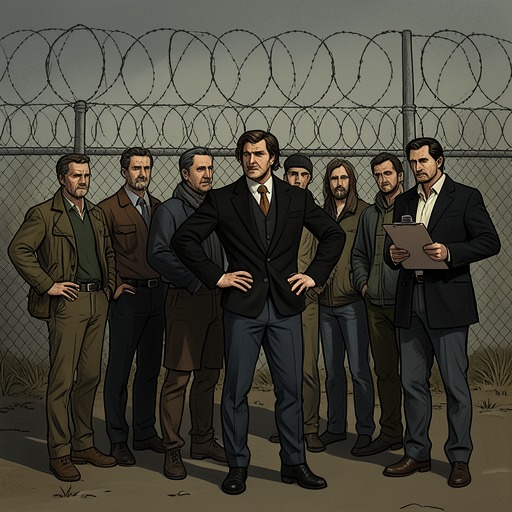
The One Law presents the Household’s purpose in collective terms: to safeguard domestic order, provide an equal share, protect the Sanctuary, establish fairness in work and trade, and defend the Colony, its material assets, and its people until the Day of Return. The council is composed of the oldest member of each surviving First Family: Patal, Jaxon, Molyneau, Fisher, Chou, Curtis, Boyes, and Norris. The provisions allow for families joined through marriage, including Walker families; if a family’s oldest surviving member declines to serve, another member of that surname may take the place.
The structure ties political authority to inherited family standing while also giving that authority a defined administrative relationship with the Board of Trades. The two bodies consult on defense, production, illumination, and the distribution of equal shares. In a dispute or civil emergency, however, the One Law reserves final authority to the Household. Its members elect one of their own as Head of the Household, who serves without the responsibilities of a secondary Trade. Terrence Jaxon is named as Head of Household in the document, with Lucy Fisher Jaxon also identified in the associated listing.
Governing the Colony
The council’s remit extends beyond deliberation: it concerns the settlement’s security and the systems on which daily life depends. Under the One Law, work inside and beyond the walls—including at the Power Station, the turbines, the grazing fields, and the pits—is divided among the Seven Trades. Weapons within the Colony are placed in the Armory under the Watch’s protection, while children remain within the Sanctuary until age eight, when they leave to select a Trade subject to the Colony’s needs and the approval of both governing bodies.
These provisions make the Household part of a closely ordered civic system, not a council concerned only with emergencies. The One Law connects family representation, labor assignments, weapons storage, childhood, and resource distribution to the continued survival of the settlement. It also makes the council a custodian of the boundaries between protected and unprotected knowledge: children in the Sanctuary are not to be told about the world outside, the Virals, the Watch’s duties, or the Great Viral Cataclysm. The rules name expulsion beyond the walls as a penalty for knowingly breaking that secrecy.
Emergency Authority and Inquest
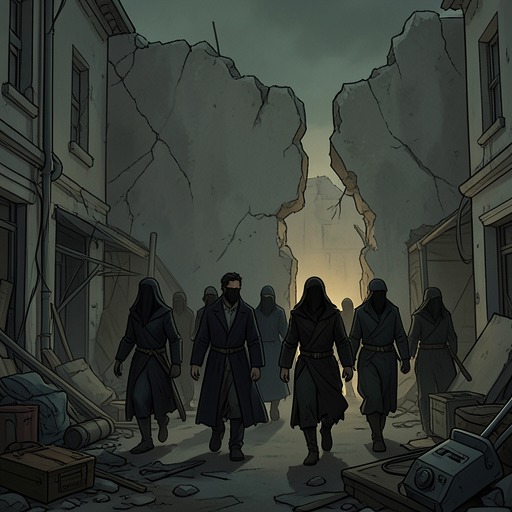
The Household’s emergency powers become visible after the night of violence and confusion that brings the wounded girl to the Colony. At first light, the council declares a state of civil emergency. It suspends activity beyond the Wall, orders the herd and Heavy Duty crews to remain inside, keeps the gate closed, and remands Caleb to the lockup. With many people lost and the Colony gripped by fear, it postpones judgment rather than passing sentence immediately.
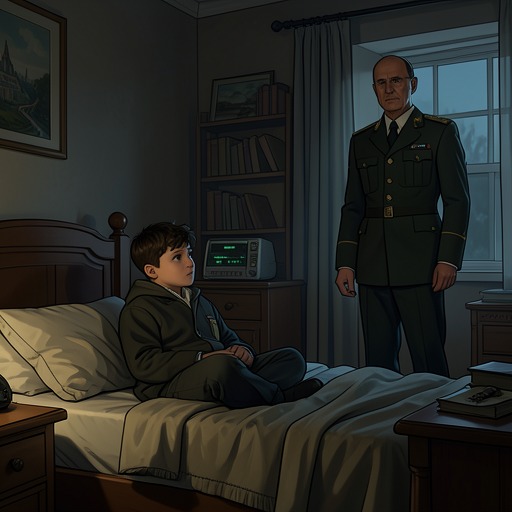
The response also places the unfamiliar girl under strict quarantine. After examining her, Sanjay orders people who have had contact with her to wash and change clothes, with their clothing burned; the girl’s backpack and clothes are burned as well. Only Sara may enter the Infirmary until the Household knows more. The measures show the council trying to manage uncertainty through containment, even as the girl’s survival and apparent lack of infection leave the central danger unexplained.
The council’s inquiry into the night’s events takes place in an old Sanctuary classroom, a setting that connects public judgment with a place associated with children’s upbringing and release into adult life. Peter, Alicia, Hollis, and Soo are questioned separately and kept from speaking to one another while they wait. In the questioning, Old Chou tells Peter that Caleb’s intention is not the issue and presses him on whether he opened the gate. Peter denies doing so. The exchange gives the inquiry a specific legal question, but Peter understands the proceedings as a search for someone to blame, exposing the distance between an institution’s stated process and how that process feels to those under scrutiny.
Breakdown and Political Significance
Later, as a crowd turns against Peter and Alicia, the Household’s authority is openly challenged. Ian announces that the Household is suspended, declares martial law, and imposes an immediate curfew. The announcement reveals both the council’s centrality and the fragility of its legitimacy: a crisis can make its ordinary procedures seem inadequate, and power can shift abruptly into emergency command.
Across these episodes, the Household is neither merely a constitutional ideal nor a neutral background institution. The One Law promises shared protection, fairness, and common defense; the emergency response applies quarantine and restriction to a frightened community; the inquest tries to establish responsibility; and the later declaration of martial law suspends the council itself. The contrast makes the Household a measure of the Colony’s changing political order. Its authority is meant to preserve collective life, yet the moments in which that authority is tested reveal how easily protection, judgment, and blame can become entangled.